Can't Fall Back Asleep After Waking Up? Try This Reset
If you can't fall back asleep after waking up, avoid turning the night into a test. Keep light and stimulation low, skip the clock, and move to a safe quiet activity if frustration builds. Return to bed when sleepiness comes back. If the pattern repeats or affects daytime safety, track it and ask for professional help.
 Lalit SAugust 29, 202611 min read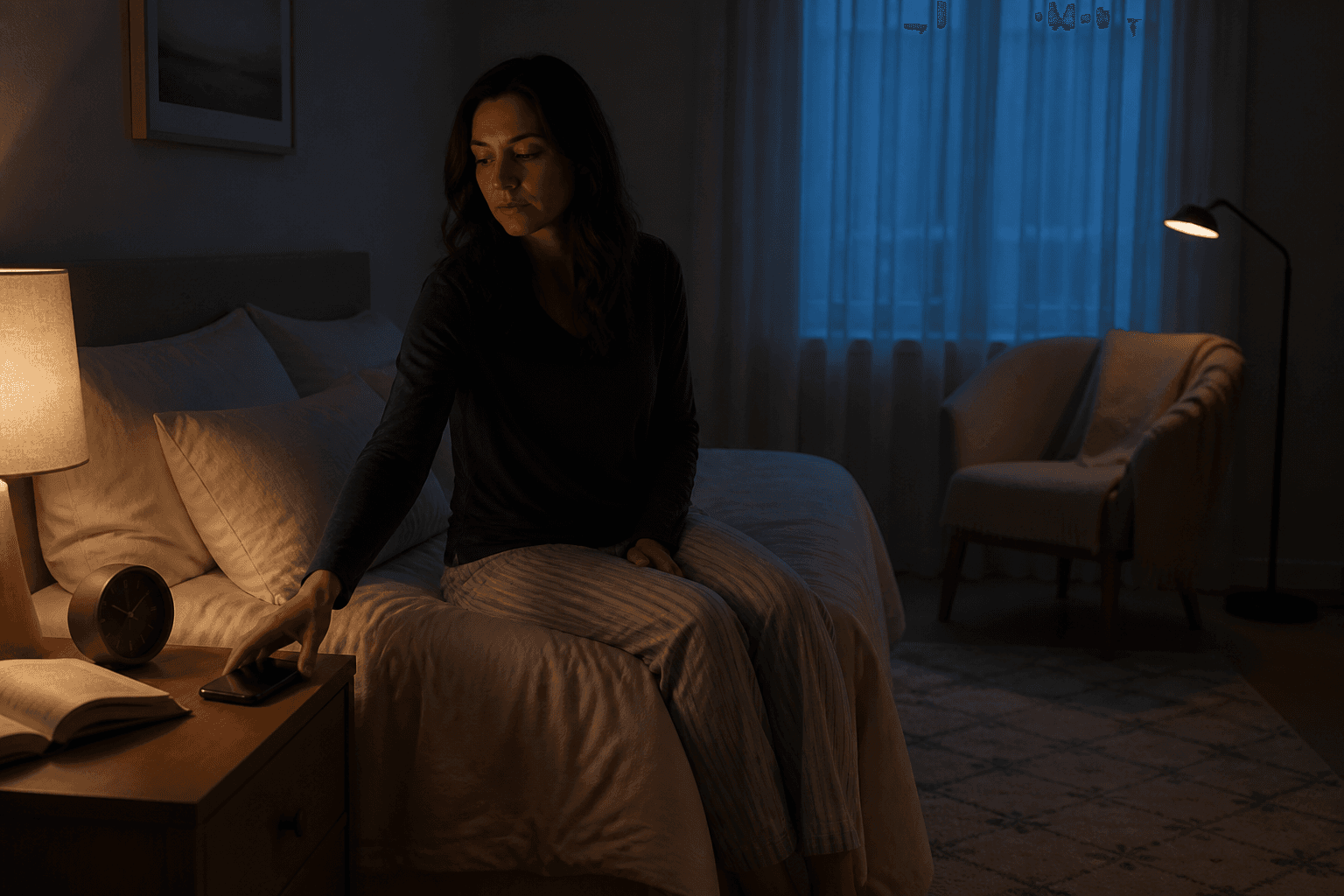
Useful health tools
Try one of our most searched health calculators.
BMI Calculator
Estimate body mass index from height and weight, with a plain-language category.
Daily Calorie Needs Calculator
Estimate maintenance calories and gentle weight-change ranges by activity level.
Sleep Calculator
Work backward from a wake-up time to estimate when to get into bed for an adult sleep target.
Quick answer: If you can't fall back asleep after waking up, avoid turning the night into a test. Keep light and stimulation low, skip the clock, and move to a safe quiet activity if frustration builds. Return to bed when sleepiness comes back. If the pattern repeats or affects daytime safety, track it and ask for professional help.
You wake in the dark, glance at the time, and immediately start calculating what tomorrow will feel like. If you can't fall back asleep after waking up, the first useful move is not to force sleep or diagnose the cause at 3 a.m. Lower stimulation, protect safety, and notice whether the wake-up was linked to noise, temperature, pain, a bathroom trip, worry, breathing symptoms, substances, or a schedule change. A repeated pattern belongs in a daytime review, not a midnight search spiral.
Why is repeated middle-of-the-night wakefulness worth tracking?
Visible top pages repeatedly advise avoiding clock-watching, reducing light, leaving bed when wakefulness becomes frustrating, and reviewing common disruptors. Many present a fixed-minute rule or a list of quick tricks. The practical gap is a decision path that separates one ordinary wake-up from a recurring problem, uses sleepiness rather than a stopwatch to guide the return to bed, and captures safety and breathing clues for a clinician.
What can a low-stimulation reset look like?
Dev wakes to use the bathroom, checks messages, and starts calculating how many hours remain. Soon he is searching for supplements. On another night, he keeps the phone face down and moves to a safe chair with a familiar paper book when frustration builds. In daylight, he records frequent bathroom wake-ups and loud snoring, then books an assessment rather than assuming stress explains everything.
What should you do during the wake-up?
- Pause before adding stimulation. Keep the room dim, leave the clock out of view, and avoid messages, work, news, symptom searches, shopping, or bright overhead lights.
- Check immediate needs without running a diagnostic checklist: bathroom, pain, reflux, temperature, noise, caregiving, or a safety concern. Address only what is necessary and calm.
- If you are resting comfortably, you do not need to start a timer. If you feel increasingly alert, frustrated, or tempted to scroll, move to a safe quiet place and choose a familiar low-stakes activity in dim light.
- Return to bed when sleepiness appears—heavy eyelids, drifting attention, or repeated rereading—not because a precise number of minutes has passed.
- Keep the next wake time reasonably consistent when it is safe, but do not drive, operate machinery, or force a risky commute when you are struggling to stay awake.
- When the pattern repeats, use the seven-night card below. Record estimates rather than chasing exact wearable scores, and stop tracking if it increases anxiety.
- Arrange care when sleep trouble persists, harms daytime function, or comes with breathing pauses, gasping, severe sleepiness, restless legs, pain, mood symptoms, hot flashes, frequent urination, or a medicine change.
Is waking during the night automatically insomnia?
No. A remembered wake-up does not by itself establish a disorder. NHLBI describes insomnia as difficulty falling asleep, staying asleep, or getting good-quality sleep despite enough opportunity and an appropriate environment, with effects on daytime activity. Short-term problems may follow stress or schedule changes; chronic insomnia follows a longer, recurring pattern that a clinician evaluates.
The useful questions are frequency, duration, time awake, and next-day impact. If you wake briefly, return to sleep, and function normally, the event may not need a label. If you spend long periods awake, dread bedtime, or struggle to work, study, care for someone, or drive safely, the pattern deserves attention.
What should you do when you can't fall back asleep after waking up?
First, stop making sleep a performance task. Hide the clock and keep light low. If you are calm, stay where you are and let rest be enough for the moment. If you become frustrated or alert, stimulus-control guidance used in cognitive behavioral therapy for insomnia supports leaving the bed for a quiet activity and returning when sleepy.
Choose a safe chair, a familiar paper book, quiet audio with the screen dark, simple knitting, or another low-stakes activity. Avoid chores that create momentum. You are not trying to exhaust or entertain yourself; you are reducing the link between bed and wakeful struggle. The site's 15-minute reset for racing thoughts at night adds a one-line thought-parking method when worry is the main fuel.
What could be waking you in the first place?
Noise, light, room temperature, caregiving, shift work, travel, caffeine, nicotine, alcohol, medicines, stress, pain, reflux, hot flashes, bathroom trips, and leg discomfort can all matter. Breathing symptoms such as loud habitual snoring, witnessed pauses, gasping, morning headaches, or marked daytime sleepiness need assessment; a wake-up alone cannot diagnose sleep apnea.
Do not try to settle the cause during the episode. In daylight, compare the site's sleep apnea warning-sign guide if breathing clues appear, or the night-sweats tracker if repeated drenching sweating is the trigger. If your larger problem is feeling unrefreshed despite enough time in bed, use the waking-up-tired clue card.
How do you build a useful seven-night wake-up card?
Use one row per night. Estimates are enough; a consumer wearable is optional and cannot diagnose the cause.
| Capture | Write down | Why it helps |
|---|---|---|
| Sleep window | Bedtime, final wake time, naps, schedule change | Shows sleep opportunity and rhythm |
| Wake-up | Approximate time, likely trigger, estimated awake period | Defines the recurring pattern |
| Night response | Clock or phone use, stayed calm, left bed, quiet activity | Shows what increased or reduced alertness |
| Inputs | Caffeine, alcohol, nicotine, medicines, late meal, exercise | Creates context for review |
| Body clues | Pain, reflux, urination, heat, legs, snoring, gasping | Flags possible contributors |
| Next day | Sleepiness, mood, focus, dozing, driving or work risk | Shows impact and urgency |
NHLBI recommends a one- to two-week sleep diary before a medical visit. Bring the card, a full medicine and supplement list, and partner observations. Do not delay care to complete seven perfect entries.
When is CBT-I more useful than another sleep tip?
Cognitive behavioral therapy for insomnia is a structured, multi-component treatment. It can include stimulus control, work on sleep-related thoughts, individualized time-in-bed changes, relaxation or counter-arousal strategies, and sleep education. The 2025 VA/DoD guideline describes CBT-I as the preferred treatment for chronic insomnia; the American College of Physicians also recommends it as initial treatment for adults with chronic insomnia.
That is different from collecting hacks. Sleep hygiene may support treatment, but the VA/DoD guidance says it should not be the only treatment for chronic insomnia. Ask a primary-care clinician or sleep professional about CBT-I or an appropriate brief alternative. Do not independently compress time in bed: excessive daytime sleepiness, bipolar disorder, seizure disorders, pregnancy, unstable illness, and safety-sensitive responsibilities may require tailoring.
What should you ask a clinician?
Try: ‘For the past three weeks, I wake around [time] on [nights per week] and estimate I am awake for [range]. The trigger seems to be [clue or unknown]. I have [daytime effect], and my partner has or has not noticed snoring, gasping, or leg movement. These are my medicines, supplements, caffeine, alcohol, and schedule changes.’
Ask what may need evaluation, what to do during wake-ups, whether CBT-I fits, and which symptoms should change the urgency.
What common fall-back-asleep mistakes should you avoid?
- Checking the time repeatedly and calculating the consequences of every lost minute.
- Staying in bed while working, scrolling, arguing, eating a full meal, or researching symptoms until the bed becomes a cue for alertness.
- Treating a rigid twenty-minute rule as a stopwatch test; estimating time in the dark can itself increase monitoring and frustration.
- Using alcohol, cannabis, antihistamines, melatonin, supplements, or someone else's prescription as an automatic middle-of-the-night rescue.
- Starting sleep-restriction instructions from social media without a trained provider, especially with bipolar disorder, seizure risk, pregnancy, excessive daytime sleepiness, or safety-sensitive work.
- Assuming every wake-up is anxiety while ignoring loud snoring, breathing pauses, gasping, pain, reflux, hot flashes, restless legs, urination, or medicine effects.
When should repeated waking get medical care?
Do not drive or do safety-critical work when you are fighting sleep. Seek urgent help for severe breathing trouble, chest pain, fainting, new confusion or weakness, or thoughts of self-harm. Arrange medical care for repeated trouble returning to sleep that affects daytime function, unplanned dozing, loud snoring with gasping or witnessed breathing pauses, severe morning headaches, worsening mood, persistent pain or reflux, frequent nighttime urination, restless legs, hot flashes, pregnancy-related concerns, or symptoms after a medicine change. Several nights of very little sleep with unusually high energy, agitation, impulsive behavior, hallucinations, or confusion needs prompt assessment.
Questions this guide answers
These are the practical questions readers usually bring to this topic. The short answers below are intentionally direct, and the surrounding sections explain the context, cautions, and when professional guidance matters.
Why do I wake up in the middle of the night and can't go back to sleep?
Stress, environment, schedule changes, caffeine, alcohol, medicines, pain, reflux, hot flashes, urination, restless legs, breathing problems, and insomnia can overlap. The trigger alone does not identify the cause, so track the pattern and daytime impact.
Should I stay in bed if I can't fall back asleep?
Stay if you are calm and resting. If frustration and alertness build, move to a safe dim place for a quiet activity, then return when sleepy; adapt this with a clinician if leaving bed creates safety risks.
How long should I try to fall back asleep before getting up?
You do not need to watch a stopwatch. Use rising frustration or full alertness as the cue for a quiet reset, and return when sleepiness—not a precise minute count—comes back.
Is waking up at 3 a.m. a sign of high cortisol?
A clock time cannot diagnose a hormone problem. Sleep stage, schedule, environment, stress, substances, symptoms, and health conditions may all matter; recurring disruptive wake-ups need a broader assessment.
When should I see a doctor about middle-of-the-night waking?
Arrange care when it repeats, affects daytime function or safety, or comes with snoring, gasping, severe sleepiness, mood changes, pain, reflux, urination, restless legs, hot flashes, or medicine changes.
Sources
Health Wellness Daily uses current public-health guidance and professional insomnia guidelines to support health claims. Sources reviewed for this article include:
- NHLBI: Insomnia symptoms
- NHLBI: Insomnia diagnosis and sleep diary
- NHLBI: Insomnia treatment
- NHLBI: Healthy sleep habits
- MedlinePlus: Insomnia
- VA/DoD: 2025 guideline for chronic insomnia and obstructive sleep apnea
- American College of Physicians: CBT-I as initial treatment for chronic insomnia
By Lalit S · Researched and sourced, not medical advice · Last reviewed 2026-08-29
A note before we start: I'm not a medical professional. This is a researched, plain-language guide with every health claim linked to a credible source so you can check it and bring it to your own doctor. It's for general education — not a diagnosis, and not a substitute for care from someone who knows your history.
How this article was made: I researched current guidance from the sources above, drafted with AI assistance, and fact-checked every claim against its source before publishing. I'm not a medical professional — corrections from clinicians are welcome at contact@healthwellnesdaily.com.
Medical disclaimer: This content is for general information only and is not medical advice. Always consult a qualified healthcare professional about your own symptoms.


Comments
Verified readers can comment. New comments are reviewed before they appear.