How to Start Exercising Again After a Break
To start exercising again after a break, use your current capacity—not your old routine—as the baseline. Begin with short, comfortable sessions, keep recovery days, and change one variable at a time. Stop for warning symptoms, and get individualized advice when illness, injury, pregnancy, disability, or a chronic condition changes safety.
 Lalit SAugust 19, 202611 min read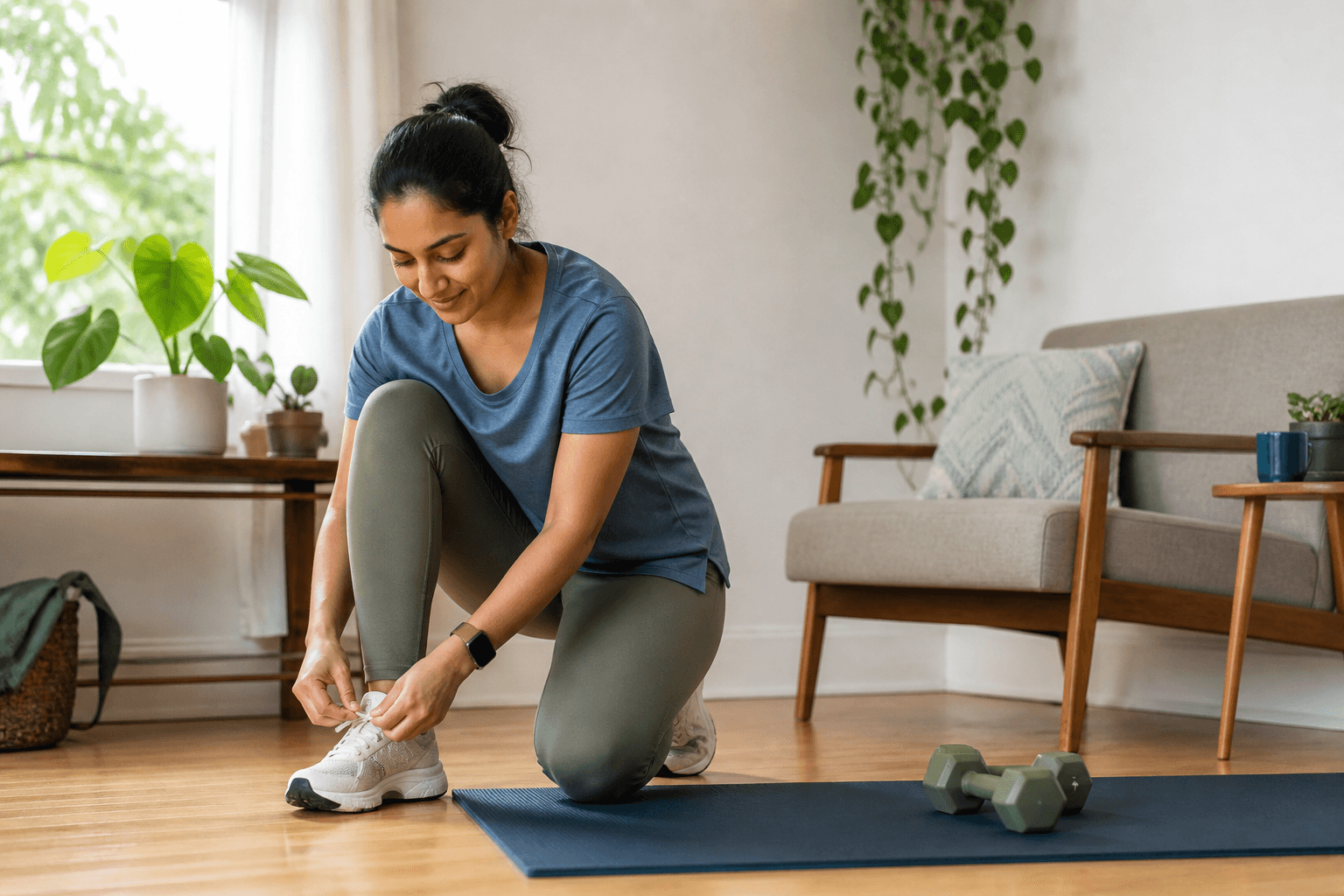
Useful health tools
Try one of our most searched health calculators.
BMI Calculator
Estimate body mass index from height and weight, with a plain-language category.
Daily Calorie Needs Calculator
Estimate maintenance calories and gentle weight-change ranges by activity level.
Sleep Calculator
Work backward from a wake-up time to estimate when to get into bed for an adult sleep target.
Quick answer: To start exercising again after a break, use your current capacity—not your old routine—as the baseline. Begin with short, comfortable sessions, keep recovery days, and change one variable at a time. Stop for warning symptoms, and get individualized advice when illness, injury, pregnancy, disability, or a chronic condition changes safety.
Your last regular workout may have been six weeks ago—or six years ago. The first session back is not a fitness test. It is a low-stakes check of what walking, basic strength movements, and recovery feel like today. A useful restart leaves enough energy to return.
Why is it worth planning how to start exercising again after a break?
Visible top search results consistently recommend starting slowly, setting realistic goals, choosing enjoyable activity, mixing cardio and strength, and allowing recovery. Their advice often stays abstract. This guide adds a flexible two-week schedule, a talk-test intensity check, and a continue-adjust-stop decision card without claiming that everyone needs medical clearance for ordinary light activity.
What can a realistic first session look like?
Priya used to attend hard circuit classes, then stopped during a demanding work project. Four months later, she is tempted to book the same class. Instead, she walks for twelve comfortable minutes, tries one set each of chair sit-to-stands, wall push-ups, and supported calf raises, and checks how she feels later and the next morning. She now has a repeatable starting point rather than a heroic one-off effort.
What should you check during your first week back?
- Choose a familiar, accessible activity and set a short endpoint before you begin—such as a ten-minute walk or one easy set of three basic movements.
- Keep the effort conversational. During moderate activity you should generally be able to talk, although not sing; if full sentences are difficult, slow down.
- Finish while your movement still looks controlled. Do not add time, speed, hills, resistance, and extra days in the same session.
- Check the response later and the next day: ordinary mild tiredness can be expected, but sharp pain, a changed gait, unusual breathlessness, dizziness, or worsening symptoms means adjust or stop.
- Repeat the same dose once or twice before progressing. When it feels manageable, add a few minutes, one set, or a small amount of resistance—not all three.
- Keep at least one easier or rest day between early strength sessions for the same muscles, and use comfortable everyday movement if it feels good.
- Write down only session type, minutes or sets, conversational effort, symptoms, and next-day response. The record should guide one decision, not grade your body.
What should your first workout after a long break look like?
Your first workout should feel like information gathering. Choose a stable route or space, a familiar movement, and an endpoint you can shorten. CDC guidance for overcoming activity barriers says to start slowly and build toward longer or more intense activity. Its disability guidance makes the same principle adaptable: a few minutes at a time can be a valid starting point, with increases over several weeks when needed.
A restart does not have to look like a gym session. Walking, wheeling, easy cycling, water exercise, dancing, gardening, or a few supported strength movements can all be useful depending on your body and environment. The every-movement-counts guide can help you choose an accessible form. If you want resistance work at home, the beginner home strength plan explains basic movement patterns and modifications.
How hard should exercise feel when you restart?
Use an effort cue that does not require a wearable. The American Heart Association describes moderate intensity as effort during which you can talk but not sing, while vigorous effort makes conversation harder. On an early restart, staying around a comfortable conversational level is a practical ceiling for many people, not a personalized prescription.
Heart rate can be affected by medicines, temperature, stress, sleep, illness, caffeine, and device error. The watch-free talk-test cardio guide explains why a number is context, not a verdict. If a clinician has given you a heart-rate, symptom, glucose, blood-pressure, or exertion plan, use that plan instead. Never push harder just to match an old watch record.
Can you use this two-week exercise restart plan?
This card is an example for an adult returning after an uncomplicated break, not rehabilitation after injury or illness. Swap the movements, shorten any session, or remain on one row longer. A session includes an easy beginning and finish.
| Day | Example session | Decision afterward |
|---|---|---|
| 1 | 10–15 minutes comfortable walking, wheeling, or cycling | Could you talk and finish with control? |
| 2 | Rest or 5–10 minutes easy mobility | Any symptom that changes the plan? |
| 3 | One easy set each: chair sit-to-stand, wall push-up, supported calf raise | Was form steady without straining? |
| 4 | Rest or ordinary comfortable movement | How is the next-day response? |
| 5 | Repeat Day 1; add up to five minutes only if it was easy | Keep, shorten, or stop? |
| 6–7 | One optional easy activity day and one rest day | Which session is realistically repeatable? |
| 8–14 | Repeat the pattern; add time or one set on only one or two sessions | Progress only if symptoms and recovery stay acceptable |
WHO and AHA activity targets describe a destination for population health, not a first-week requirement. Some activity is better than none, and people can build toward larger weekly totals. If ten minutes is too much, begin with a smaller dose. If it is very easy, repeat it before deciding what to add.
How do you know whether to continue, adjust, or stop?
Continue: breathing settled as expected, you could speak comfortably, movement stayed controlled, and any mild tiredness or diffuse soreness is improving. Repeat the session before adding one small variable. Adjust: the session left you unusually drained, soreness changes ordinary tasks, sleep or symptoms worsened, or you needed to alter your movement. Shorten the next session, reduce effort, or ask a qualified professional for help.
Stop and seek care: chest pressure, fainting, severe or unusual breathlessness, new neurologic symptoms, rapidly worsening pain, or another emergency sign occurs. The site's muscle soreness versus injury check can help you describe timing, location, function, and trend, but it cannot diagnose an injury. Do not repeat a painful movement to prove that it is safe.
Should you restart cardio and strength together?
You can include both across the week, but neither needs to be hard. WHO and AHA guidance includes aerobic activity plus muscle-strengthening activity because they train different capacities. Early on, a short conversational walk and supported strength movements on separate days can be enough.
Avoid turning the guideline total into a deadline. Increase gradually, and ask for an adapted option when symptoms, disability, pregnancy, medication, or a health condition changes the plan. On busy days, a brief movement snack can preserve the routine without a punishment workout.
What common restart mistakes should you avoid?
- Starting with the workout, pace, weight, or class level you used before the break.
- Treating intense soreness, exhaustion, or a high heart-rate reading as proof that the comeback worked.
- Following a rigid two-week plan despite pain, illness, poor recovery, or clinical restrictions.
- Adding daily workouts, a restrictive diet, supplements, and a sleep overhaul all at once.
- Using a watch's calorie estimate or fitness score as permission to ignore symptoms.
- Assuming every person needs a stress test or medical clearance before gentle movement—or assuming nobody needs individualized advice.
When should you seek medical care?
Seek urgent care for chest pressure, severe or unusual shortness of breath, fainting, new confusion, one-sided weakness, or another emergency symptom. Dark tea- or cola-colored urine with severe muscle pain or weakness also needs immediate assessment because CDC/NIOSH lists that pattern among possible rhabdomyolysis signs. Arrange guidance if you are recovering from surgery, significant injury, serious illness, pregnancy or recent birth, or if a chronic condition, balance problem, or disability affects activity. Prompt review is also sensible for symptomatic palpitations, repeated dizziness, swelling, altered movement, or symptoms that recur with exertion. Follow your care team's restrictions over this general plan.
Questions this guide answers
These are the practical questions readers usually bring to this topic. The short answers below are intentionally direct, and the surrounding sections explain the context, cautions, and when professional guidance matters.
How long does it take to get fit again after a break?
There is no single timeline. It depends on the length and reason for the break, previous training, current health, sleep, nutrition, age, and the type of fitness you are rebuilding. Track function and recovery rather than promising yourself a deadline.
Should I start exercising every day after being inactive?
Not necessarily. Everyday light movement may suit some people, but early structured sessions can be separated by easier or rest days, especially strength work for the same muscles. Build frequency only when your response is acceptable.
How much should I reduce my old workout?
No universal percentage is evidence-based for every break and every person. Choose a deliberately short, comfortable baseline, repeat it, then add only one variable when your symptoms, form, and recovery support that choice.
Do I need to see a doctor before restarting exercise?
Many adults can begin with light activity, but individualized advice matters after significant illness, surgery or injury and when pregnancy, disability, symptoms, chronic conditions, or clinician restrictions affect safety. Emergency symptoms need urgent care, not clearance for another workout.
Is soreness normal when you start exercising again?
Mild diffuse soreness can occur after unfamiliar activity, but soreness is not required for progress. Sharp or focal pain, swelling, weakness, altered movement, dark urine, or symptoms that worsen need a more cautious response.
Sources
Health Wellness Daily uses credible medical and public-health sources to support health claims. Sources reviewed for this article include:
- CDC: Overcoming barriers to physical activity
- CDC: Physical activity for adults with disabilities
- WHO: Physical activity fact sheet
- American Heart Association: Recommendations for physical activity in adults
- American Heart Association: Getting started with physical activity
- MedlinePlus: Exercise and physical fitness
- Cleveland Clinic: Getting back to exercise after a long break
- CDC/NIOSH: Signs and symptoms of rhabdomyolysis
By Lalit S · Researched and sourced, not medical advice · Last reviewed 2026-08-19
A note before we start: I'm not a medical professional. This is a researched, plain-language guide with every health claim linked to a credible source so you can check it and bring it to your own doctor. It's for general education — not a diagnosis, and not a substitute for care from someone who knows your history.
How this article was made: I researched current guidance from the sources above, drafted with AI assistance, and fact-checked every claim against its source before publishing. I'm not a medical professional — corrections from clinicians are welcome at contact@healthwellnesdaily.com.
Medical disclaimer: This content is for general information only and is not medical advice. Always consult a qualified healthcare professional about your own symptoms.


Comments
Verified readers can comment. New comments are reviewed before they appear.